Mexican National Patrol Police
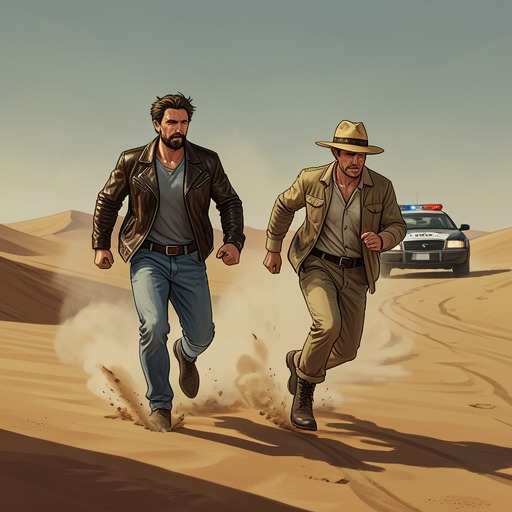
Cry MachoThe Mexican National Patrol Police is presented through its officers in the field rather than through an account of its formal structure. During the search for Mike Milo and Rafo, patrol units help turn the roads into checkpoints: officers inspect travelers, search a vehicle, consult the family involved, and move to arrest both the boy and the man accompanying him. The force’s pursuit gives practical shape to the story’s border, where papers and legal claims matter but do not settle what has happened to Rafo or where he should go.
Field Presence and Road Surveillance
The organization enters the pursuit as part of a wider police search. Mike encounters a roadblock on the route north of San Luis Potosí, where a national patrol car and a police motorcycle barricade the road. A policeman and three national troopers are searching passing vehicles. Mike notices that their attention seems fixed less on goods than on drivers and passengers, making the stop a search for people rather than contraband. His suspicion that they may be looking for Rafo turns the halted line of cars into an immediate threat: he returns to his truck and makes a U-turn to leave the main highway.
The chase is not confined to the capital or to one uniformed unit. Later, when Rafo scouts the upper town, he returns anxious because the officers he saw were not from the Distrito Federal. Jiménez knows them as police from north of the town, and Rafo warns that they know the back roads better than he and Mike do. Their reach makes the countryside no reliable refuge. The pursuit has become a network of local knowledge and patrol movement, narrowing the pair’s options even away from the main road.
Stops, Searches, and Identification
The force’s most sustained encounter with Mike and Rafo comes at an inn, where a sergeant and a younger driver search them and the truck. The driver searches their clothing, then methodically ransacks the vehicle, including the concealed space beneath the spare tire, the cab, and the engine area. He eventually tears out the upholstered seat and slashes it with a pocketknife. The sergeant’s repeated reference to narcotics gives the search an initial emphasis on suspected smuggling, even though the officers have stopped a man and a boy whose circumstances are also at issue.
The sergeant asks for Mike’s tourist card, which Mike produces from his coat. The document establishes a formal basis for his presence in Mexico, but it does not resolve who Rafo is traveling with or why. The sergeant then asks about the boy. That shift—from checking a traveler’s papers to investigating the relationship between an adult and a child—brings the suspected kidnapping into the open. The search shows how the organization’s scrutiny works in practice: identity papers, physical inspection, and questioning are used together, while the officers’ initial suspicion of narcotics does not account for the full situation.
Arrest and Competing Accounts
At the inn, the sergeant contacts the national police, as well as Rafo’s mother and father. He tells Rafo that the police are looking for him in the Distrito Federal for truancy, petty theft, and resisting arrest. His mother says she will not defend him, explaining that she does not know how to do so and that he may need to learn that the law is the law. Howard Polk, by contrast, denies knowing anything about the affair, despite Rafo’s insistence that his father sent for him. The officers’ inquiries thus expose a sharp conflict between the boy’s understanding of the journey and his father’s denial.
After these calls, the sergeant tells Mike and Rafo that they are both under arrest for kidnapping and will be taken to the Distrito Federal. The announcement is more than a change in Mike’s legal status: it makes the police’s interpretation of his act decisive in the immediate encounter. Mike had treated the journey as taking Rafo to his father under a visitation agreement; the sergeant treats the same journey as a crime. The episode places formal claims, parental statements, and a child’s account alongside one another without making them equivalent or resolving their underlying dispute.
Cross-Border Failure and Narrative Role
The arrest does not end the pursuit. Mike escapes from the inn in the truck and drives toward the border, with the sergeant and his driver following. He aims for a ravine whose trees and scrub might conceal him and whose thicket crosses the border into Texas. The boundary is therefore both a physical route to safety and the limit of the officers’ immediate reach. Once Mike and Rafo are on the other side, the sergeant telephones an American contact and has to clarify that the fugitives are in Texas: not two men, but a man and a boy, one American and one Mexican.
The sergeant leaves the inn after paying the bill and cursing his slow-moving driver. He appears to postpone reporting the escape to his superiors until he can do so in person, anticipating the difficulty of explaining both a failed narcotics search and a failed kidnapping arrest over a faulty telephone connection. This ending gives the organization a concrete, limited role in the novel: its officers can stop traffic, search a vehicle, pursue suspects, and invoke arrest, but they cannot prevent Mike from exploiting the border’s geography. Their procedural authority is real, while the final outcome is a failure of pursuit rather than a completed return of Rafo to either parent.